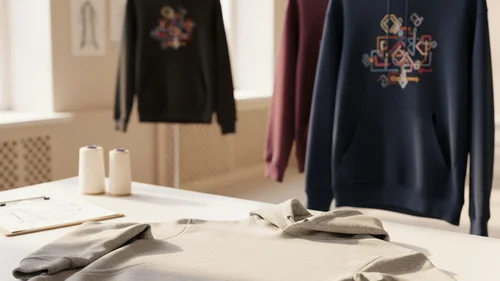

Custom Hoodies Online: What You Need to Know Before Ordering
Ordering custom hoodies online sounds straightforward until you receive 50 units with faded prints, wrong sizes, or fabric that pills after two washes. The gap between expectation and reality trips up first-time buyers more than any other custom apparel category.
This guide covers the practical decisions that determine whether your custom hoodies online order succeeds or becomes an expensive lesson. You will learn which printing method matches your design, how fabric weight affects comfort and durability, and the questions to ask vendors before committing to production.
Choosing the Right Hoodie Style for Your Project
Pullover Hoodies: The Versatile Standard
Pullover hoodies dominate custom orders for good reason. The large, uninterrupted front panel provides maximum space for logos, graphics, and text. Screen printing and DTG work exceptionally well on pullovers because the flat surface allows for consistent ink application.
Best for:
- Corporate team uniforms
- Event merchandise with prominent branding
- Streetwear-style designs with large graphics
- Schools and sports teams
Consider alternatives when: You need quick on-and-off functionality or plan to layer over other branded items.
Zip-Up Hoodies: Layering and Flexibility
Full-zip hoodies offer practical advantages that pullovers cannot match. Employees appreciate the ability to unzip when moving between warm and cold environments. The split front panel does limit design placement, but many brands turn this constraint into a feature by placing logos on sleeves or using the back panel.
Best for:
- Work environments with temperature variation
- Trade shows where staff move between indoor and outdoor spaces
- Athletic teams needing quick warmup layers
- Casual corporate apparel
Design limitation: Front designs must work with or around the center zipper.
Lightweight vs Heavyweight: Understanding Fabric Weight
Hoodie weight directly impacts comfort, durability, and printing quality. Most custom hoodies online fall into three categories:
Lightweight (5-7 oz): Ideal for layering, indoor events, or warmer climates. DTG printing works well, but the thinner fabric shows print texture more visibly.
Midweight (8-10 oz): The most popular choice for custom hoodies online. Balances warmth with year-round wearability. Supports all printing methods effectively.
Heavyweight (11+ oz): Premium feel with maximum warmth. Embroidery looks particularly impressive on heavyweight fleece. Higher material cost but perceived as more valuable by recipients.
Printing Methods Compared: Which Works for Your Design
Screen Printing: Best for Large Orders with Simple Designs
Screen printing remains the industry standard for custom hoodies online orders exceeding 24 pieces. The process involves creating separate screens for each color in your design, then pressing ink through mesh onto the fabric.
Advantages:
- Lowest per-unit cost at volume
- Vibrant, opaque colors even on dark hoodies
- Durable prints that outlast the garment
- Works on virtually any fabric type
Limitations:
- Setup costs make small orders expensive
- Each color requires a separate screen
- Photorealistic images lose detail
- Gradients and subtle shading rarely work well
Cost structure: Expect setup fees between $20-50 per color, with per-unit costs dropping significantly above 50 pieces.
Direct-to-Garment (DTG): Ideal for Complex Graphics
DTG technology prints designs directly onto fabric using specialized inkjet printers. This method handles photographic images, unlimited colors, and intricate details that screen printing cannot achieve.
Advantages:
- No setup costs make single-unit orders viable
- Unlimited color count at no extra charge
- Photorealistic printing capability
- Soft hand feel with no raised texture
Limitations:
- Higher per-unit cost at volume compared to screen printing
- Works best on 100% cotton or high-cotton blends
- Colors appear more vibrant on light-colored hoodies
- White ink base required for dark fabrics adds production time
Best applications: Custom hoodies online with detailed artwork, small batch orders, or when you need to produce multiple unique designs.
Embroidery: Premium Branding That Lasts
Embroidered custom hoodies online convey quality and permanence. The textured, dimensional finish catches light differently than printed designs, creating visual interest that flat printing cannot replicate.
Advantages:
- Professional, upscale appearance
- Extremely durable through years of washing
- Does not crack, fade, or peel
- Works on any fabric weight or color
Limitations:
- Higher cost per piece than printing
- Small details and gradients do not translate well
- Design size limitations based on hoop sizes
- Thread colors must be specified exactly
Design guidelines: Keep embroidered designs under 15,000 stitches for cost control. Simple logos with clean lines produce the best results.
All-Over Printing (Sublimation): Full-Coverage Designs
Sublimation allows designs to cover the entire hoodie, including seams. The process converts solid dye into gas, which bonds permanently with polyester fibers.
Advantages:
- Edge-to-edge design coverage
- No texture or hand feel difference
- Extremely durable and wash-resistant
- Vibrant, saturated colors
Limitations:
- Requires polyester or poly-blend fabric
- Cannot print true white (fabric color shows through)
- Higher complexity increases production cost
- Color accuracy varies between production runs
Common Mistakes When Ordering Custom Hoodies Online
Mistake 1: Ignoring Fabric Composition
The fabric blend directly affects how your custom hoodies online look, feel, and last. A 50/50 cotton-poly blend resists shrinking but may pill over time. 100% cotton offers superior softness but shrinks 3-5% after first wash. Ring-spun cotton provides a smoother printing surface than open-end cotton.
Solution: Request fabric specifications before ordering. Ask about shrinkage expectations and care instructions.
Mistake 2: Choosing the Wrong Print Method for Your Design
A complex gradient logo printed via screen printing will lose detail and appear muddy. Conversely, a simple two-color logo printed via DTG costs more than necessary without quality benefit.
Solution: Match your design complexity to the printing method. Simple designs with 1-4 solid colors suit screen printing. Photographic or gradient designs require DTG.
Mistake 3: Skipping the Sample Process
Samples cost money and add time, but skipping them risks receiving hundreds of hoodies with problems you could have caught. Colors appear differently on fabric than on screens. Sizing varies between manufacturers.
Solution: Order at least one production sample before committing to full orders. Verify color accuracy, print placement, and sizing fit your expectations.
Mistake 4: Underestimating Size Distribution
First-time buyers often order based on their own size assumptions. Standard size distributions rarely match actual needs, especially for diverse groups. Running out of popular sizes frustrates recipients and wastes budget on unworn inventory.
Solution: Survey recipients before ordering or use data-driven size distributions based on demographic profiles.
Mistake 5: Overlooking Care Instructions
Custom hoodies online with improper care instructions damage prints prematurely. Screen prints crack when dried on high heat. DTG prints fade with harsh detergents. Embroidery pulls when caught on zippers in the wash.
Solution: Include specific care instructions with delivered hoodies. Consider printing care symbols inside the garment.
Mistake 6: Ordering Without Vector Files
Bitmap images (JPG, PNG) lose quality when scaled. Vendors stretch low-resolution files to fit design areas, resulting in pixelated, unprofessional prints. Vector files (AI, EPS, SVG) scale infinitely without quality loss.
Solution: Always provide vector files for logos and text. Convert bitmap artwork to vectors before submitting orders.
How to Evaluate Custom Hoodie Vendors Online
Production Transparency
Reputable vendors provide clear information about their production process. You should know where hoodies are manufactured, what printing equipment they use, and how they handle quality control.
Questions to ask:
- What brand blanks do you use?
- Is printing done in-house or outsourced?
- What is your defect rate and how do you handle replacements?
Realistic Turnaround Times
Standard production for custom hoodies online runs 7-14 business days, not including shipping. Rush services exist but cost more and increase error rates. Vendors promising 3-day turnaround on custom embroidered hoodies are either cutting corners or misleading you.
Questions to ask:
- What is the production timeline for my specific order?
- Does your timeline account for proofing and approval stages?
- What happens if production delays affect my deadline?
Proofing Process
Professional vendors provide digital proofs showing exact print placement, colors, and sizing before production begins. Some offer physical proofs for an additional fee. Never approve production without seeing a proof that matches your expectations.
Questions to ask:
- Do you provide digital proofs before production?
- Can I request a physical sample before bulk production?
- What is your revision process if the proof needs changes?
Use Cases: Matching Hoodies to Your Purpose
Corporate Team Apparel
Companies ordering custom hoodies online for employees face different priorities than event organizers. Durability matters more than bold graphics. Embroidered logos on midweight zip-ups allow professional layering while maintaining brand presence.
Recommended setup:
- Midweight (8-10 oz) zip-up hoodie
- Embroidered logo on left chest
- Neutral colors (charcoal, navy, black)
- Size survey before ordering
Event Merchandise
Festival and conference hoodies serve as both apparel and souvenirs. Recipients want visually interesting designs they will actually wear after the event ends. DTG or screen printing allows for more creative freedom.
Recommended setup:
- Midweight pullover hoodie
- Large back graphic with front left chest design
- Event-themed colors
- Order 10-15% extra in popular sizes
Sports Teams and Clubs
Athletic organizations need custom hoodies online that identify team members while withstanding regular use. Numbering and names add personalization but increase production complexity.
Recommended setup:
- Heavyweight fleece for outdoor warmth
- Screen printed team logo with embroidered name/number
- Team colors with contrast accents
- Pre-shrunk fabric to maintain sizing consistency
Promotional Giveaways
Custom hoodies online for promotional purposes prioritize brand visibility over individual preference. Recipients receive what you provide, so quality reflects directly on brand perception.
Recommended setup:
- Midweight pullover in single color
- Large, clear logo placement
- Standard size distribution (S-XL focus)
- Quality that recipients will actually wear
Preparing Your Design Files for Production
Resolution Requirements
Screen printing and embroidery work from vector files. DTG can use high-resolution raster images but vectors produce better results.
File specifications:
- Vector formats: AI, EPS, SVG, PDF (with embedded fonts)
- Raster minimum: 300 DPI at actual print size
- Color mode: CMYK for printing, specific thread colors for embroidery
Color Considerations
Colors on your screen rarely match colors on fabric. Request Pantone color matching for exact brand colors. Understand that DTG colors appear differently on dark versus light hoodies due to white underbase requirements.
Design Placement
Standard placements include left chest, full front, full back, and sleeves. Each location has size limitations based on printing equipment. Provide specific measurements if precise placement matters.
FAQ
How many custom hoodies online should I order as a minimum?
Screen printing typically requires 12-24 piece minimums to offset setup costs. DTG and embroidery often accept single-unit orders but at higher per-unit prices. Many vendors offer no-minimum options through print-on-demand services.
What is the typical turnaround time for custom hoodies online?
Standard production runs 7-14 business days after proof approval. Add 3-7 days for shipping. Rush services can reduce production time but expect 30-50% premium charges.
How do I ensure accurate sizing when ordering custom hoodies online?
Request the vendor's size chart specific to the hoodie brand and style you selected. Order samples in multiple sizes before bulk production. Survey recipients if distributing to a group.
Can I order custom hoodies online with different designs in the same order?
Most vendors accommodate multiple designs within single orders, but pricing structures vary. DTG handles design variation easily. Screen printing may charge additional setup fees per unique design.
What fabric blend works best for custom hoodies online?
Cotton-poly blends (60/40 or 50/50) offer the best balance of comfort, durability, and print quality. 100% cotton maximizes softness but shrinks more. 100% polyester is required for sublimation printing.
How do I care for custom printed hoodies to maintain print quality?
Turn hoodies inside out before washing. Use cold water and mild detergent. Avoid high-heat drying, which can crack screen prints and fade DTG prints. Line dry or tumble dry on low heat.
What file format should I submit for custom hoodie designs?
Vector files (AI, EPS, SVG) work best for all printing methods. If submitting raster images, provide at least 300 DPI resolution at the intended print size. Avoid JPG compression artifacts.
How do I compare quality between different custom hoodie vendors?
Request samples from multiple vendors before committing to large orders. Compare fabric weight, print quality, color accuracy, and construction details like stitching and drawstring quality.
Summary
Ordering custom hoodies online successfully requires matching your specific needs to the right combination of hoodie style, fabric weight, and printing method. Screen printing delivers the best value for large orders with simple designs. DTG handles complex graphics and small quantities. Embroidery provides premium branding that outlasts the garment.
Avoid common mistakes by requesting samples, providing vector files, and surveying recipients for accurate size distribution. Evaluate vendors based on production transparency, realistic timelines, and clear proofing processes. The extra preparation time invested before ordering prevents costly revisions and disappointed recipients after delivery.