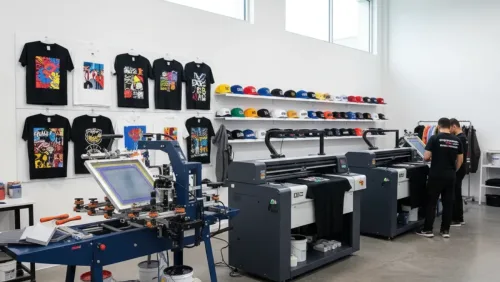

Custom Printing: Best B2B Playbook for 2026
In B2B, custom printing goes wrong when expectations are not measurable. If you cannot describe the finish, color target, and defect rules in writing, you cannot buy consistency.
This custom printing guide is built for procurement: method selection, a spec brief you can reuse, sample gates, and receiving checks that protect your brand.
Selection Guide: Best Custom Printing Methods by Use Case (2026)
Choose custom printing methods based on artwork complexity, material, and durability requirements.
Screen printing
Best for: bold graphics, spot colors, repeat runs that need consistent look.
Avoid when: the artwork has photo-level detail or frequent version changes.
DTG (direct-to-garment)
Best for: highly detailed artwork, multi-color images, short design cycles.
Avoid when: you need a very specific hand feel or strict color repeatability across different blanks without testing.
Heat transfer
Best for: quick personalization, small marks, controlled placement on tricky garments.
Avoid when: the garment will see heavy abrasion or high-heat laundering without validation.
Sublimation
Best for: all-over graphics on polyester, vibrant prints that become part of the fabric.
Avoid when: the product is cotton-heavy or you need exact color matching without profiling.
Embroidery (for comparison)
Best for: premium uniform marks, long wear, textured branding.
Avoid when: the artwork depends on gradients or micro-detail.
Technical Comparison: What Procurement Should Lock
Custom printing success depends on controlling what changes the output.
Material and pretreatment
The same art prints differently across fabric blends and finishes. Lock the blank identifier (brand/model/color) and require approval for substitutions.
Color targets
Define color targets and how they are verified. Require the supplier to confirm their color-matching approach in writing and to validate on the actual material.
Placement and scale
Provide a placement map with measurements from seams and edges. Include an “orientation” rule so the mark stays level on different sizes.
Durability expectations
Define the required durability in plain language: wash resistance, stretch tolerance, and abrasion expectations. Validate with a physical sample, not assumptions.
Common Mistakes and How to Avoid Them
Mistake 1: Picking a method before locking the blank
Method selection without the actual material leads to surprises. Choose the blank first, then validate the method on that blank.
Mistake 2: Approving a mockup instead of a physical sample
Mockups hide real texture, opacity, and hand feel. For custom printing, the sample is the contract.
Mistake 3: No defect definitions
If defects are not defined, disputes are guaranteed. Define what counts as misregistration, banding, fading, cracking, or placement drift.
Mistake 4: Artwork files are “close enough”
Poor source files force the supplier to improvise. Provide final artwork, confirm the print size, and require written confirmation that the file is production-ready.
Mistake 5: No change control
Small changes create new outcomes: blank substitutions, new inks, different curing settings. Require approval for any process change after sample sign-off.
Practical Tips: Spec Brief, Files, and Sample Gates (2026)
The custom printing spec brief (one page)
Include:
- Product + blank identifier and substitution policy: not allowed unless approved
- Method (screen printing, DTG, heat transfer, sublimation) and finish expectations
- Placement map with measurements and orientation
- Color targets and how they are checked
- Packaging requirements and carton labeling
- Acceptance criteria, defect rules, and remake process
File requirements that reduce rework
- Prefer vector for logos and spot-color art
- Provide a layered source file when edits are expected
- Specify the final print size and safe area
- Include a reference image of the intended look on the correct garment color
Sample gate you can enforce
- Pre-production sample: method + blank validation
- Golden sample: archived reference for reorders
- Pilot run check: quick approval before the bulk run ships
Vendor Selection: Best Scorecard for Custom Printing (2026)
Choose custom printing vendors based on control, traceability, and repeatability.
Procurement scorecard (what to verify)
- Process control: documented proofing, stored settings for reorders
- Quality checks: in-process inspection, final inspection, documented rework handling
- Traceability: batch IDs tied to blank and settings
- Communication: single owner, clear escalation path, written confirmations
- Capacity planning: ability to hold schedules and manage changes without silent substitutions
Evidence to request
- Confirmation of the locked blank and method
- The placement map and acceptance criteria
- How reorders are reproduced (stored settings + archived sample)
- How defects are classified and resolved
FAQ
How do I choose a custom printing method for my program?
Start with the blank and artwork constraints, then validate the method with a physical sample. If durability and repeatability are critical, prioritize methods that you can control and measure on the chosen material.
What should I approve before starting custom printing production?
Approve a physical sample and keep it as the golden sample. Confirm the blank, placement map, and defect rules in writing before any bulk run begins.
What files should I send for custom printing?
Send vector artwork when possible and specify the final print size. Include a reference image so the supplier knows what “correct” looks like on the target product.
How do I reduce color surprises?
Provide clear color targets and validate on the actual blank. Avoid approving color from screen previews.
What should be on a receiving checklist?
Spot-check placement, visible defects, consistency across cartons, and durability cues against the golden sample. Document findings so reorders improve instead of drifting.
How do I keep reorders consistent across vendors?
Lock the blank, archive the golden sample, and enforce change control. Use the same spec brief and acceptance criteria for every supplier.
Summary
The best custom printing outcomes come from procurement discipline: lock the blank, document the spec, approve a physical sample, and enforce clear defect rules. Treat the golden sample as your reference, and custom printing stays consistent across runs and suppliers in 2026.